
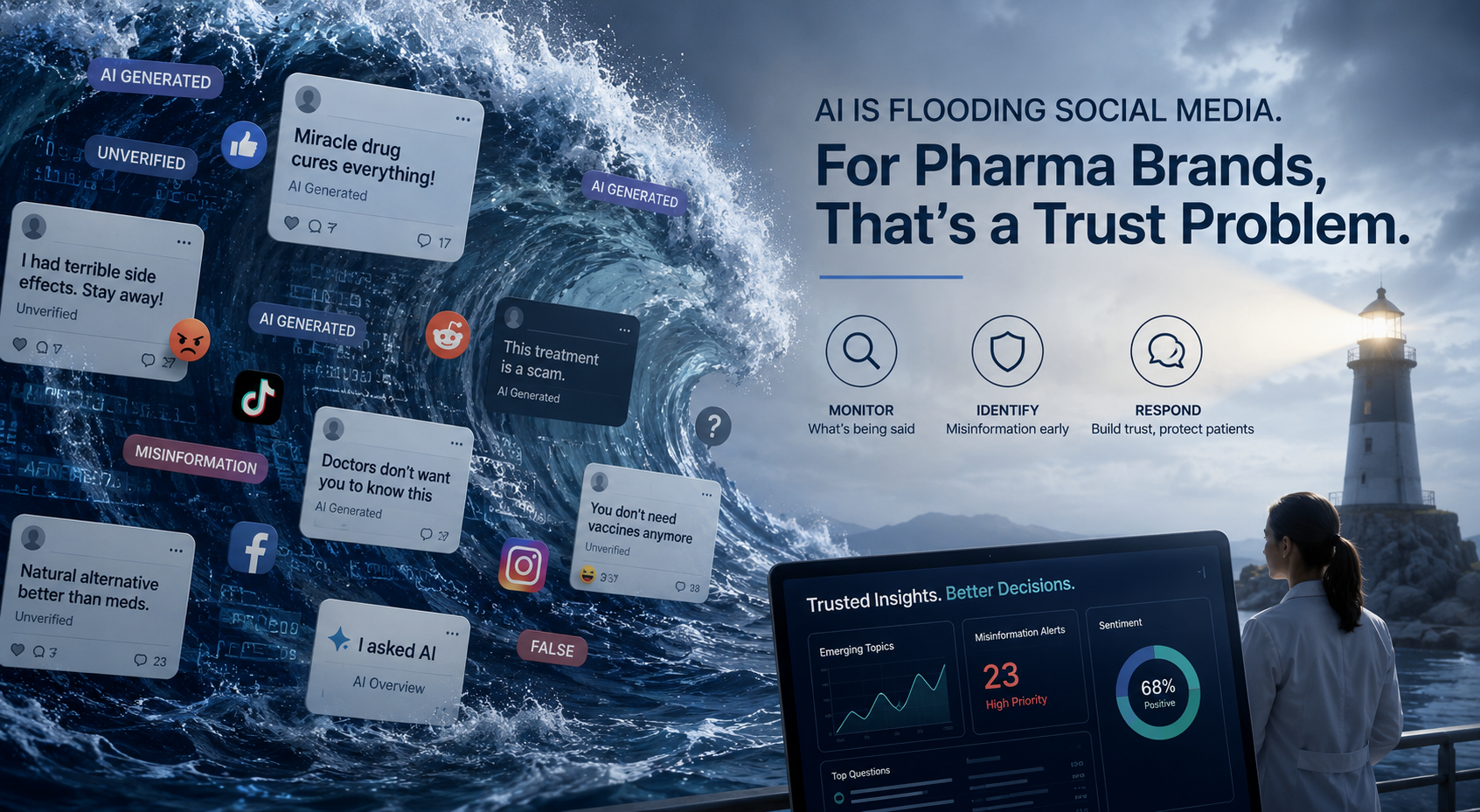
AI Is Flooding Social Media. For Pharma Brands, That’s a Trust Problem.

The internet has always had a misinformation problem. Artificial intelligence is simply making it faster.
As generative AI becomes embedded in social media platforms, search engines, and everyday workflows, we’re entering a period where content can be created and amplified at a scale we’ve never seen before. AI-generated posts, comments, summaries, and even conversations are becoming increasingly difficult to distinguish from authentic human interactions.
A recent Social Media Today article asked an important question: Can social media survive the flood of AI content?
It’s an interesting debate. But for pharmaceutical companies, the more important question isn’t whether social media survives. It’s whether patients can still trust what they find there.
The stakes are higher in healthcare
When someone is shopping for shoes, a bad product recommendation is frustrating. When someone is researching a medical condition or treatment, bad information can influence healthcare decisions, erode confidence in therapies, or delay conversations with a healthcare professional.
Patients are increasingly turning to Reddit, Facebook Groups, TikTok, disease communities, and other social platforms to ask questions that feel too personal or too urgent for a search engine alone. They compare side effects, discuss treatment experiences, debate insurance coverage, and seek reassurance from people who’ve “been there.”
These conversations have always mattered. Now they’re being accelerated and amplified by AI.
An inaccurate comment can be copied into another discussion, summarized by an AI tool, cited by a blog, and eventually influence the answers patients receive from AI-powered search experiences. Information doesn’t just spread faster; it becomes more difficult to trace back to its source. In healthcare, that makes trust both more fragile and more valuable.
Reputation isn’t built by what brands publish alone
For years, digital reputation centered on owned content: your website, your social channels, your press releases. Today, your reputation is also shaped by what patients say, what caregivers share, what healthcare professionals discuss, and what AI systems synthesize from those conversations.
In other words, your brand story is being written in places you don’t own. Often, the most influential conversations aren’t happening in the original post. They’re unfolding in the comments.
That’s where patients compare experiences. Where misconceptions gain traction. Where anecdotes become accepted as evidence. And where one unanswered question can spark hundreds of replies; some helpful, some misleading, and some generated by AI rather than lived experience.
Ignoring those conversations doesn’t make them disappear. It simply means someone else is shaping the narrative.
Social listening isn’t enough anymore
For years, social listening has helped pharmaceutical companies understand what patients, caregivers, and healthcare professionals are saying online. It has been an invaluable tool for measuring sentiment, identifying trends, and monitoring brand conversations.
But the rules have changed. When AI can create and amplify misinformation in seconds, simply listening is no longer enough. Brands can’t afford to be passive observers of conversations that shape patient perceptions and influence treatment decisions.
Today’s environment requires a more proactive posture, one that continuously identifies emerging misinformation, detects shifts in disease-state conversations, surfaces reputational risks before they escalate, and equips teams to respond thoughtfully and compliantly when it matters most.
The objective isn’t to control the conversation. It’s to ensure that credible, evidence-based information has a voice within it.
Pharma needs a more proactive playbook
This is why social media monitoring has evolved beyond measuring sentiment or counting brand mentions.
Pharma organizations need a more proactive strategy, one that continuously identifies emerging misinformation, tracks conversations around disease states as well as branded therapies, surfaces evolving patient concerns, and highlights discussions that could influence trust.
The goal isn’t to jump into every conversation. It’s to understand where accurate information is needed most and where a thoughtful, compliant response can make a meaningful difference.
That may mean recognizing a recurring misconception about a therapy before it spreads widely. It may mean identifying new patient questions that should inform educational content. Or it may simply mean understanding how conversations are shifting so communication strategies can evolve alongside them. The brands that earn trust tomorrow will be the ones paying attention today.
More data isn’t the answer. Better intelligence is.
The challenge is that AI is generating more content than any human team could reasonably monitor. That’s why the next generation of social intelligence isn’t about collecting more mentions. It’s about extracting trustworthy insights from an increasingly noisy digital landscape.
This is where purpose-built AI becomes essential.
Rather than treating every online conversation as equally valuable, intelligence systems like LiveInsight AI™ are designed to help healthcare organizations distinguish meaningful signals from digital noise. By combining AI with healthcare-specific knowledge, curated data sources, and human expertise, organizations can uncover insights that are grounded, explainable, and relevant; not simply generated by another large language model.
Equally important, healthcare AI must help reduce the risk of misinformation and AI hallucinations rather than amplifying them. Decision-makers need confidence that the insights informing brand strategy, patient engagement, and reputation management are based on credible evidence and traceable sources.
In an age of AI-generated content, trusted intelligence becomes a competitive advantage.
Social media and AI search are now connected
Another shift is quietly changing how healthcare brands should think about reputation.
Patients aren’t just searching Google anymore. They’re asking ChatGPT, Gemini, Perplexity, and other AI assistants to explain symptoms, compare treatments, and summarize what people are saying online. Those systems don’t create answers in a vacuum. They synthesize publicly available information from across the web, including news articles, forums, social discussions, and community conversations.
That means today’s online discussions can influence tomorrow’s AI-generated answers.
For pharmaceutical companies, social media monitoring is no longer just about understanding conversation. It’s about understanding the broader information ecosystem that shapes patient perception. Managing brand reputation increasingly requires visibility into both human conversations and the AI-powered experiences built upon them.
Trust is becoming pharma’s most valuable digital asset
The volume of AI-generated content will only continue to grow. The organizations that thrive won’t be those trying to compete with AI by producing more content. They’ll be the ones committed to ensuring that accurate, evidence-based information remains visible, that emerging misinformation is identified early, and that patient conversations are understood, not simply measured.
That requires a proactive approach to reputation management, intelligent monitoring of social and AI-driven conversations, and technology capable of turning overwhelming volumes of data into trusted insight. Because in a world where almost anyone or anything can create content, trust is no longer defined by who publishes first.
It’s defined by who consistently helps people find information they can believe.