
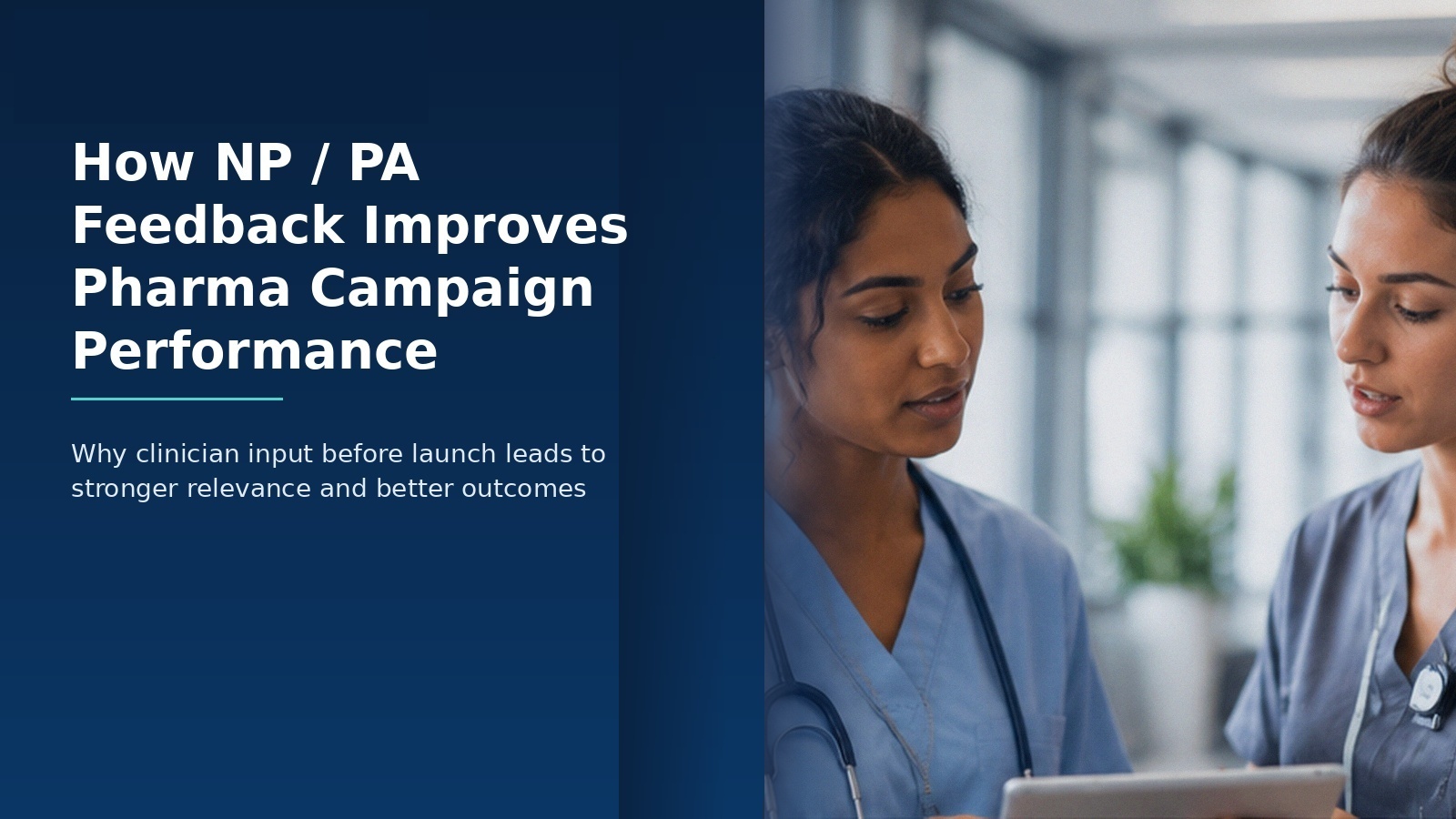
Clinician-Informed Creative: How NP/ PA Feedback Improves Pharma Campaign Performance

Before media dollars go live, validate whether your concepts, claims, and assets feel credible, useful, and relevant to NPs (Nurse Practitioners) and PAs (Physician Assistants). A simple pre-launch testing workflow can reduce waste and improve engagement.
Pharma teams are getting smarter about Advanced Practice Providers (APPs). More brands now recognize that NPs and PAs play a central role in patient care, treatment education, and prescribing influence. But there is still a common failure point in APP marketing: teams update the audience strategy without updating the message.
A media plan can be well targeted, well funded, and well optimized and still underperform if the creative does not feel built for APPs. Too often, marketers take physician-first messaging, swap the audience, and hope it lands. That is a risky assumption.
APPs often evaluate content through a slightly different lens. They spend more time in patient education, work inside collaborative care models, and look for resources that fit real clinical workflow. They notice quickly when content is too abstract, too promotional, or disconnected from day-to-day practice. That is why pre-launch validation matters.
If you want stronger APP campaign performance, test your concepts, messaging, and assets with APPs before the media plan goes live.
Why Pre-Launch Testing Matters for APP Campaigns
Pre-launch testing is not about adding friction. It is about removing avoidable waste. When an APP campaign misses, the problem is usually not reach. It is relevance.
The headline may sound physician-centric. The proof points may be technically correct but not clinically useful. The visuals may not reflect the care setting. The call to action may ask too much too early. None of those are media problems. They are message problems.
The good news is that message problems are often highly fixable before launch and much more expensive to fix after media spend is already in market. A lightweight validation process can help teams identify what feels credible, what feels useful, and what still needs work before impressions start accumulating.
What to Test Before the Media Plan Goes Live
- Claims clarity: Can APPs quickly understand the clinical takeaway? Strong supporting data does not help if the core point is buried, overloaded, or phrased in a way that feels difficult to apply.
- Tone: Does the content feel helpful and respectful, or overly promotional? APPs often respond better to language that supports decision-making and patient care rather than broad brand-first copy that could apply to any audience.
- Asset usefulness: Does the asset give APPs something they can actually use? That might be a short explainer, a case-based teaching point, a discussion guide, or a resource worth saving for later.
- Patient education value: Because APPs often play a major role in counseling and adherence conversations, materials should help them explain treatment, expectations, and next steps through clear, practical patient education materials.
- Peer credibility: Peer credibility matters. Does the message sound like it understands clinical reality? Would an APP believe this content was shaped by clinicians who work in similar settings and face similar patient questions?
- Rep support and follow-through: If paid media drives response, what happens next? Field materials, follow-up email, and education resources should reinforce the same message and level of usefulness. Disconnected follow-through weakens trust.
A Simple Four-Step Validation Framework
- Concept review: Put early concepts in front of a small APP advisory group or research panel and treat the process as a source of actionable insight, not just approval. Evaluate headline territory, primary value proposition, imagery, evidence hierarchy, and initial calls to action. Ask simple but revealing questions: Would this make you stop? Is the promise believable? What feels missing?
- Rapid refinement: Use that feedback to tighten message architecture, replace weak proof points, sharpen visuals, and improve usefulness. Creative and compliant thinking matters here. Often small changes make a large difference: reframing the headline around practical patient management, simplifying claims language, or adding an education-support angle.
- Second-pass check: Re-test revised assets to confirm that the changes improved clarity and credibility. This is also the moment to assess channel fit and media strategy. A concept that works in a webinar invitation may need a different treatment in paid social, endemic display, or rep follow-up email.
- Launch readiness: Go live only after you know which assets are strongest, which messages are most believable, and which support materials are needed around them. That gives brand teams more confidence and gives media teams better inputs from day one.
What Brands Gain When They Validate Early
- Less wasted media. Better creative means fewer impressions spent on messages that were never going to resonate.
- Stronger engagement. When the message feels clinically relevant and useful, APPs are more likely to click, watch, save, or act.
- Better internal confidence. Brand, agency, legal, and medical teams can move forward with clearer evidence that the campaign is on the right track.
- More relevant assets. Testing often reveals not only what to say, but what formats to build next for APP audiences.
This does not need to become a massive research program. A focused pre-launch read with the right APP voices can surface the biggest issues quickly. And because APPs are a distinct audience, that feedback is often materially different from what physician-only review would reveal.
The Bottom Line
The smartest APP campaigns are not just targeted well. They are informed well.
Before you invest in media, pressure-test whether your concepts, claims, and creative actually work for the clinicians you want to influence. In a market where budgets are tight and performance expectations are high, clinician-informed validation is one of the fastest ways to de-risk an APP campaign before it goes live.
LiveWorld helps pharma brands do exactly that. Through our APP Advisory Council and Research Panel, we bring frontline clinician feedback into strategy, creative development, and pre-launch optimization so campaigns are more credible, more relevant, and better positioned to perform.
Want to sharpen an APP campaign before launch? Start with one concept, one message set, or one asset family and validate it with APPs before the media plan goes live.
Related LiveWorld resources:
- eBook: The APP Imperative. Why Pharma Needs a New Marketing Playbook
- Infographic: The APP Opportunity: Facts and Figures
- Webinar: DHC Group: Unlock the Power of NPs & PAs in Your HCP Marketing Strategy
- Blog Post: Why Targeting NPs and PAs Can Transform Your HCP Media Performance
- Servies: LiveWorld APP Program Overview